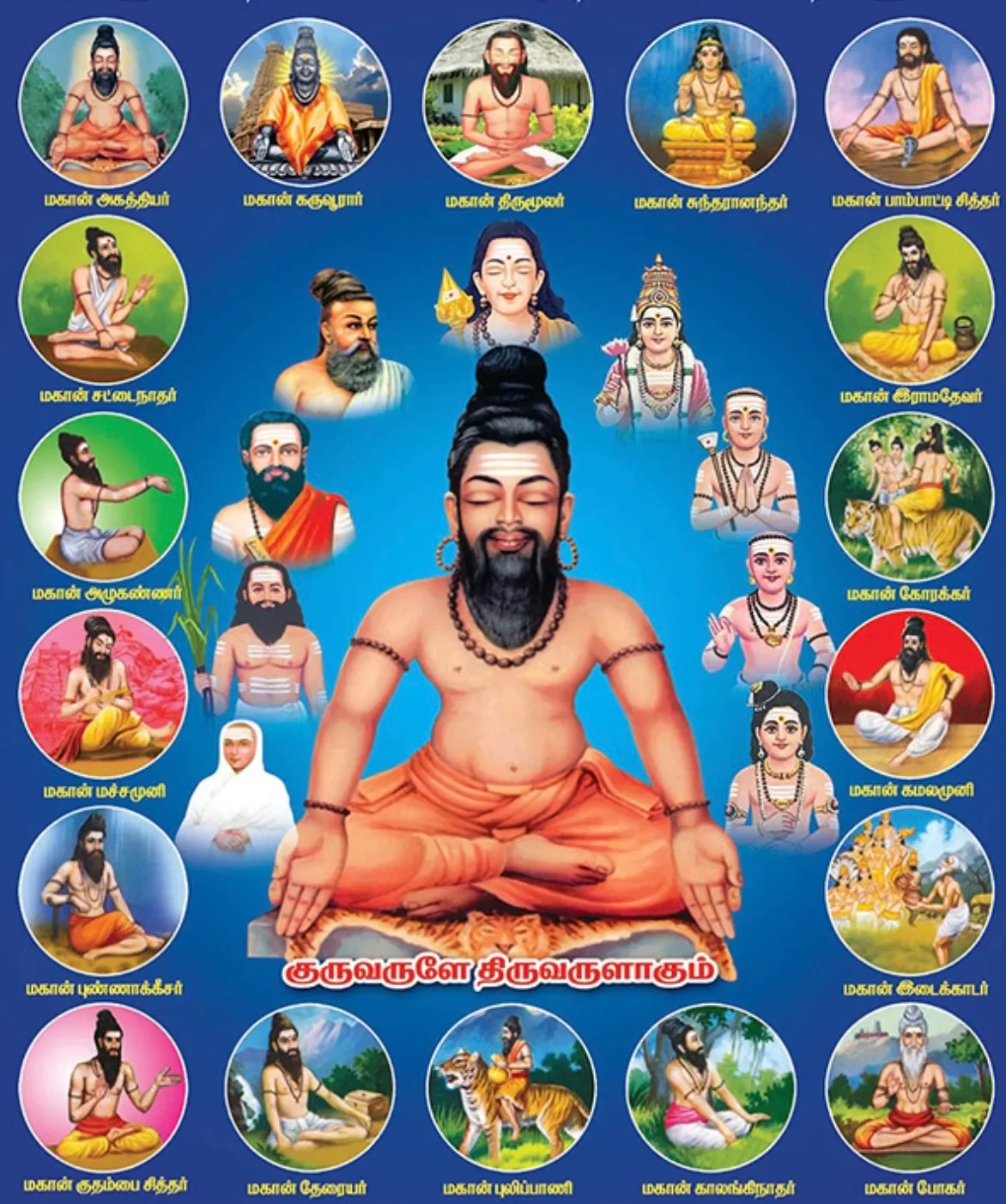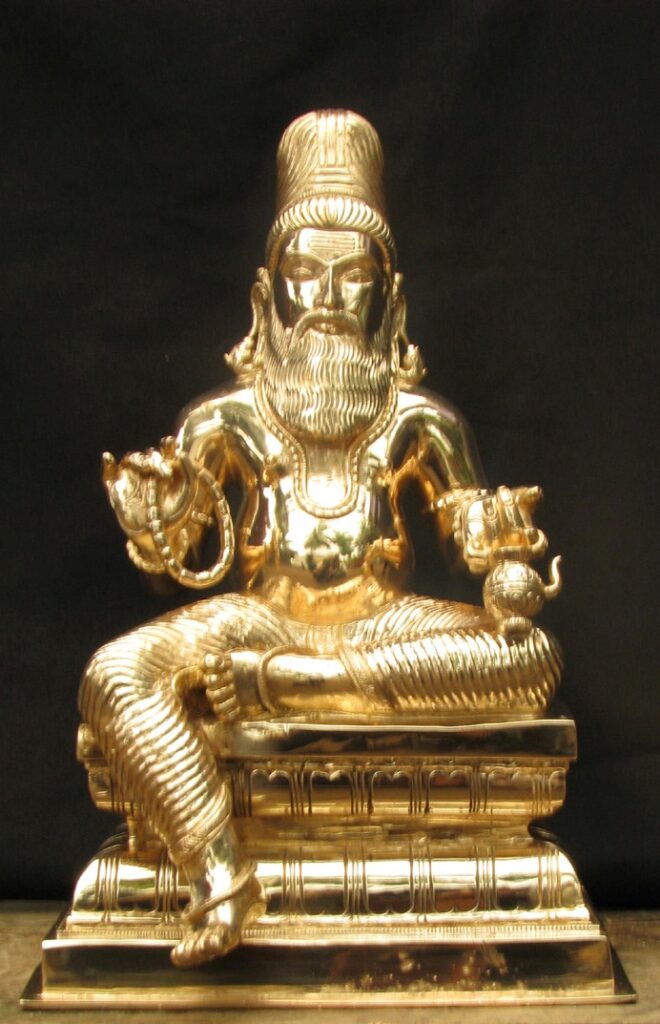
BRIEF LIFE HISTORY OF SOME OF THE SIDDHARS:
Agathiyar Siddhar
Agathiyar, also known as Agastya, is a revered figure in Tamil culture and Siddhar tradition, considered the first Siddhar and the father of Tamil literature. He is credited with composing the first Tamil grammar, Agathiyam, and is revered as a great sage and scholar in various fields, including language, alchemy, medicine, and spirituality.
Key Aspects of Agathiyar's History and Significance
Karuvoorar Siddhar
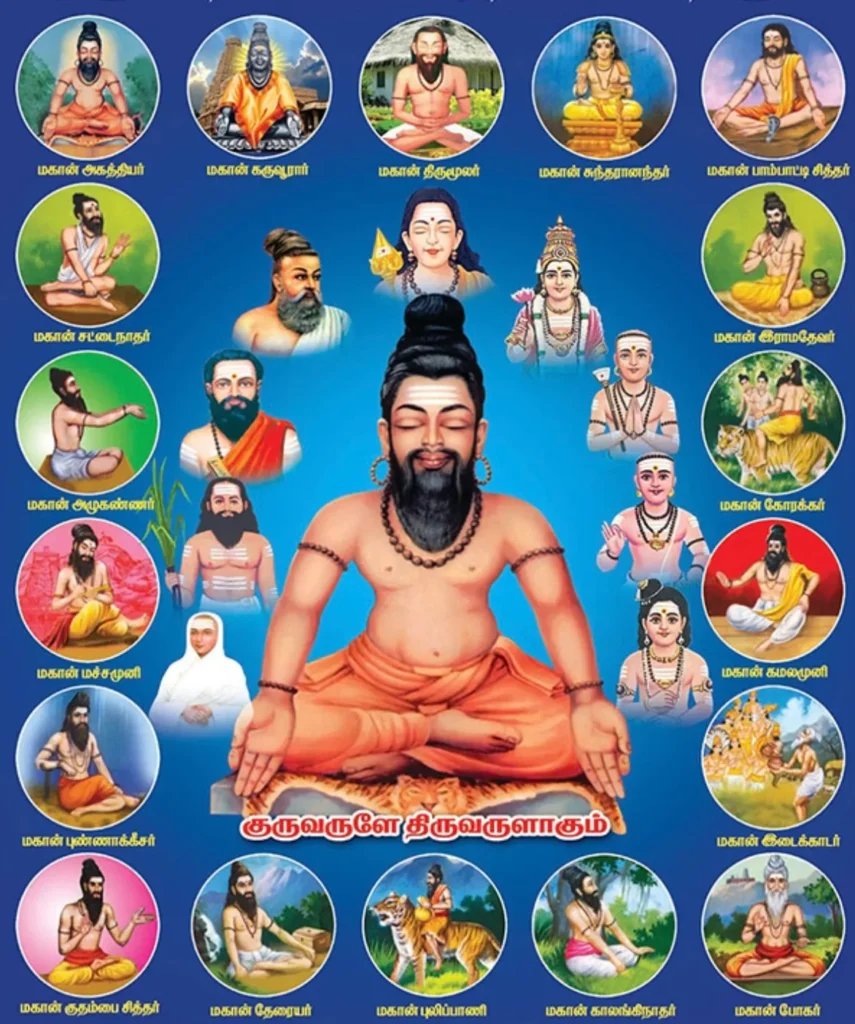
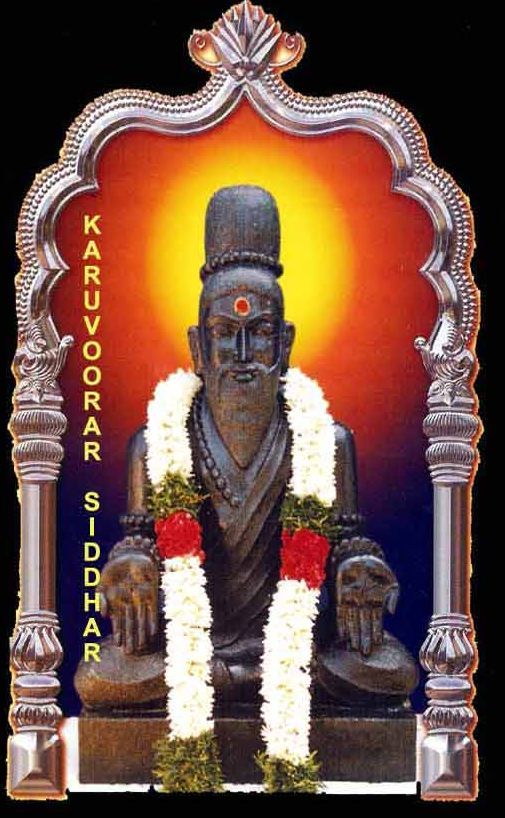
Karuvoorar Siddhar was born in a place called Kaur in Tamilndu,India. He became disciple of Siddhar Bogar. There are also popular accounts of Karuvoorar Siddhar’s significant contribution to the completion of marvellous Brihadeeswarar Temple at Thanjavur, India. The visionary King Raja Raja Cholan, while building this temple encountered serious mystical and methodical challenges. The priests found it impossible to fixate the huge Shiva Linga on the base for the sanctum sanctorum of the temple. King sought the help of Karuvoorar Siddhar.
Karuvoorar Siddhar is said to have achieved the impossible.
Karuvoorar Siddhar also guided in the mounting of the 80 tonnes heavy capstone atop the 225 feet tall Gopuram. He could lift the stones just with sound resonance. Today visitors to the temple can also see a shrine of Karuvoorar Siddhar in the temple premises.
His discoveries and improvements in the practice of alchemy are humongous.
Karuvoorar Siddhar seemed to be merged with shiva linga in his last day at Pasupatheesvar temple in Kaur.
He has done exemplary literary works also. Siddhar Karuvurar is distinguished for his work of “Attama siddhi”- eight types of miracles, in which he himself got mastered. Siddhar karuvoorar has the power of arresting problems which have been created by planet Saturn.
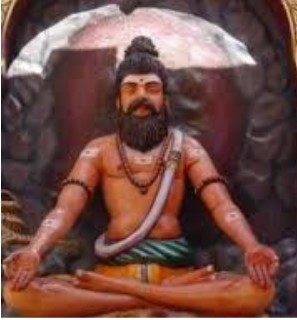
BOGAR SIDDHAR:
Bogar Siddhar is considered as one of the 18 Siddhars born in the world. According to epigraphical sources and his book Bogar Seven thousand his period is around 3000 B.C. Bogar born at India and visited China, he gained knowledge in medicine, astrology, spirituality, yoga etc.
Bogar anticipating that in due course of period, human beings will suffer from large number of diseases. As an expert in medicine, he used 4448 rare herbs and made 9 poisonous medicines, mixing these 9 poisons into one need great knowledge and skill, to make a Master Medicine (One medicine to cure all diseases).
With the consultation of Agasthiar ( Father of Ayurvedic Medicine) and other Siddhars, Bogar mixed the 9 poisons ( Nava Bashanam ) and made the Master Medicine in the form of Lord Murugan which is currently worshiped at Palani Murugan temple. There is a place near Palani Hill called Thanasiappan Temple which is the place were Bogar mixed the Nava Bashanam and made the Murugan idol.
Bogar and others then decided that by using the milk and panchamirtham ( a sweet recipe ) poured on the idol, one can extract the medicine from the idol. The milk and panchamritham then becomes medicine to cure disease. After installing Lord Murugan Navabashana idol at the Palani Hill, Bogar used to worship it with milk abishegam (pouring milk on the idol ) and panchamirtha abishegam ( pouring panchamirtham on the idol ).
His disciple Pulipani Siddhar then took over the job of Lord Murugan pooja after Bogar went into Nirvigalpa Samadhi – the highest samadhi stage; where the Mind dissolves with Matter and Energy. Bogar Samadhi is inside Palani Murugan temple at Palani Hill. Actually, Bogar himself constructed his samadhi exactly under the Lord Murugan Navabasha idol and went into Nirvigalpa Samadhi there. The entrance to his samadhi is a cave like structure, now also worship for this great Siddhar is conducted at this entrance where he is last seen by his disciples which is at the Palani temple.
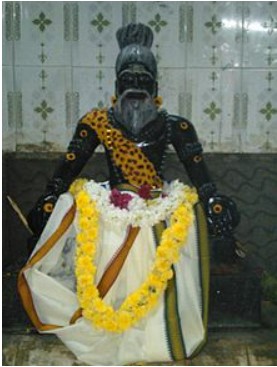
THIRUMOOLAR SIDDHAR:
Thirumoolarm Siddhar is considered to have lived about 2,500 years before, in the sixth century B.C. According to the internal evidence he was one of the eight disciples of ‘Nandi (the Supramental Ishwara)’. Thirumoolar, Vyagra Padar and Patanjali are considered to have worshipped at the temple of Chidambaram,Tamilnadu when they sought to realize the Sky of Truth-Knowledge. Thirumoolar travelled the country up and down twice. He finally settled in Thiruvaduthurai,Tamilnadu, India. He lived there long years under Bodhi Tree or Fig tree. Among the disciples of Nandi, four had already become Nandi or Nathars and assumed the name of Nandi, the other four including Thirumoolar now became Nathars by the Grace of the Lord and went into the four directions to propagate the Truth of all-fulfilling divine Lore.
He says that he came to the earth (i.e., took birth here on the earth) by the word and command of the Lord, the Player or Dancer of Ananda of Truth-Consciousness Light (Mei Jnana Joti Ananda Kooththan), i.e., the supramental Ishwara and came down from Kailas, the supreme Heaven (the Super mind), through the descending worlds of devas, asuras and naras – Possibly Soma, Brahma, Rudra are the godheads of the higher world who became his disciples or served him to obtain his Grace. Tirumoolar uses the word “kailas” in several mantras to signify Supermind. He calls the supramental Ishwara as Nandi or Per Nandi.
The other four disciples of Thirumoolar were of the earth and they had the Grace of the Lord to follow the discipline (Nyama) in all conditions of life. Swami Ramalingam of the nineteenth century A.D. (1821-1874) regarded Thirumantram of Thirumoolar as the shastra.
We have used the word “Maha Samadhi” here to signify a technical death when his soul departed from the transformed deathless body according to the divine will, and not under compulsion of the inconscient law of death.
There is at present the famous “Thiruvavaduthurai Mutt” and the ancient Siva temple in Thiruvavaduthurai. In the outer courtyard of the said temple, a shrine for Thirumoolar was found and he is worshipped even today. His image is taken out in procession once in a year along with the deity of the temple. Stone inscriptions and monuments have been later found evidencing the existence of a number of mutts there and the nature of various activities, cultural and spiritual, which were carried on in honour of his name and glory, viz., arts, dance and dramas, etc.
We do not know what happened to his deathless body. Though his body was deathless by itself with power to live on continuously, it is evident from internal evidences in the nature of general mantras that he should have left it behind to be preserved in Samadhi – as he strongly advocated the preservation of the body of Siva Jnana Siddhar in Samadhi for the eternal good of the people of the earth and that the king of the place should protect it. Possibly the said shrine was built over his samadhi as is the practice in Tamil Nadu, South India. He also gave instructions as to how a Samadhi should be built and maintained and also the evil effects which would follow if the body of such a Siva Jnana Siddhar were set to flame and burnt, or buried in mud without constructing a Samadhi or tomb
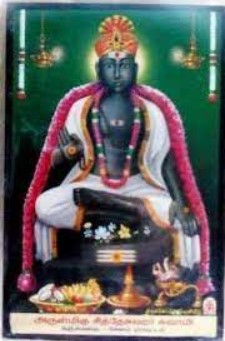
Kanjamalai siddhar
Kalangi Nathar was the guru of Bogar. Kalangi Nathar and Bogar were considered to possess an ideal master and student relationship. It is said that they had a mutual care among both of them in their own spiritual progresses. Kalangi Nathar, especially took more care and strain towards the spiritual advancement of his disciple Bogar. Kalangi Nathar was behind Bogar’s every development and his innovations for the world.
He is often referred to as Kanjamalai Siddhar. The word “kanjam” stands for the following meaning — gold, copper and Iron and malai means hill. It is said that King Paranthaka Chozha who built Sri Nataraja temple at Chidambaram with golden roof, took the gold from this hill. Also, the water falls seen in this hill is called “Ponni Nadhi”.
He is the disciple to the great siddhar Thirumoolar. He is one among the seven disciples whom Thirumoolar transcended his knowledge, the other six being Indran, Soman, Rudhran, Kanduru, Brahman and Kanjamalaiyan.
Once Thirumoolar and Kalanginathar came to this place. As the Guru was hungry, the disciple started preparing food. For stirring the food, he took a stick from a nearby bush. Immediately, it turned black. The disciple thought that the food was unfit for the Guru and he prepared fresh food and consumed the blackened food. To his amazement, he became very young. When the Guru saw this, he wanted to retrieve the magic stick. Unfortunately, the disciple had already threw it in the fire. The Guru asked the disciple to vomit part of the food and ate the vomited food stuff. He also became very young. The Guru renamed his disciple as Kanjamalai Siddhar after the name of the hill.
Kanjamalai Siddhar Temple,Salem :
This temple is around 14 Kms west of Salem on the foothills of Kanjamalai, one of the hills overlooking Salem town. This place is very famous and well known among the Tamils on account of Siddha Cult. Siddhas were the devotees of Lord Shiva and they were all said to be well versed with Medical Science.
Another legend claims that a devotee of Lord Shiva came to this place and worshipped in the Karpuranathar Temple for a long time. Pleased with his penance, the Lord gave him the status of a Siddha and gave him the boon of formlessness in Kaliyuga and this Siddhar is called Kanjamalai Siddhar.
This hill is believed to be full of rare medicinal plants. While there is a small Shiva shrine on top of the hill, the main worship is done in the foothills. The Lord is called Siddheswarar. He sits in the Chin Mudra pose. There is a large Nandi in front of the Lord. Since special poojas are offered on the new moon day ( Amavasya ), this is popularly known as Amavasai Koil in Tamil.
Get in touch with us!
Whats App
+91 44 8939955025
siddharastro25@gmail.com
Phone
+91 44 8939955059; +91 44 8939955025
Website
www.siddharastro.in
Address
Chennai, Tamil Nādu, India